

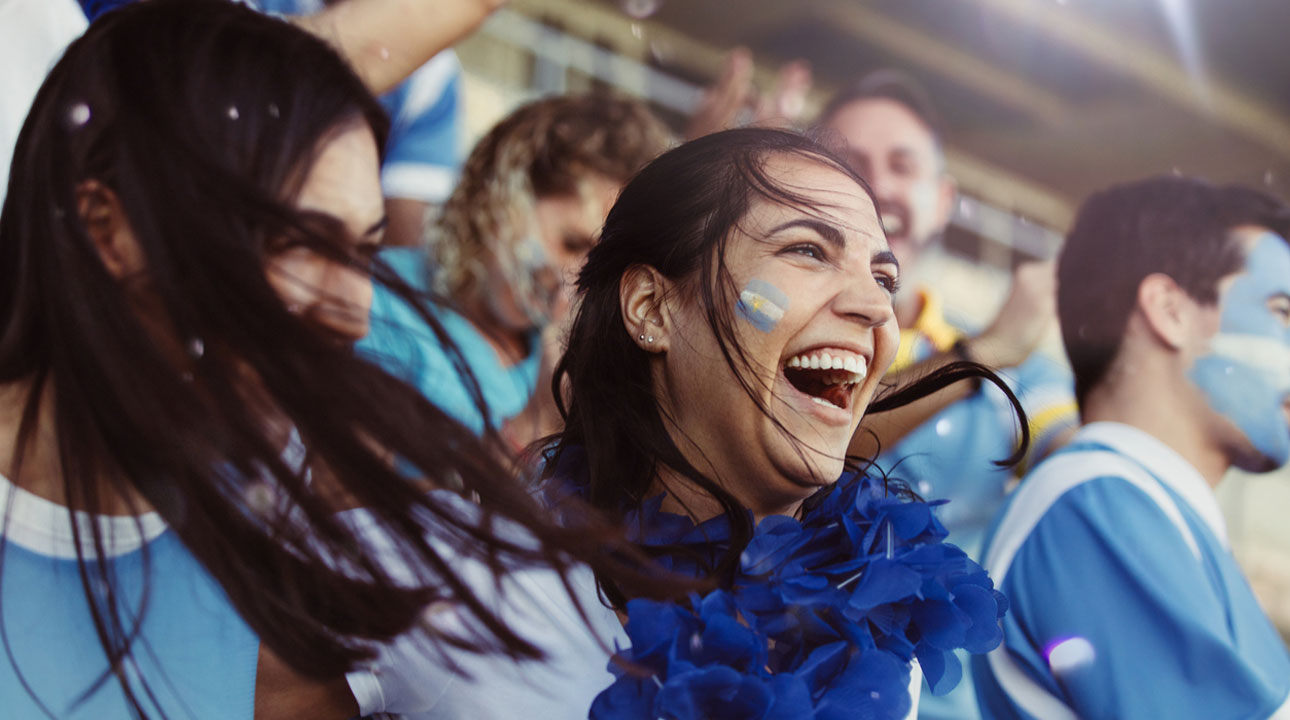
Walk through almost any World Cup watch party or fan fest in the U.S. this summer and you’ll find people who refuse to fit neatly into a single demographic box.
Countless U.S. born fans are supporting Team USA and the national teams tied to their parents or grandparents. A Mexican American proudly wears El Tri green. A Colombian American cheers for Colombia. A Paraguayan American spends ninety tense minutes watching the U.S. play Paraguay. None of them are uncertain where they belong. They’re expressing identities that have always existed side by side.
A U.S.-born fan might wear the American jersey to one match and a Mexican, Colombian, or Panamanian one to the next — not out of divided loyalty, but because both are simultaneously theirs. Which one shows up often depends on who they’re with, what the match means, or what feels right in the moment. Neither cancels the other.
The World Cup isn’t creating this behavior. It makes visible something marketers have been slow to recognize: millions of Americans move fluidly across cultures, communities, and languages because those identities genuinely belong to them.
There’s a name tied to this phenomenon: code-switching.
Traditionally, code-switching describes shifting language or behavior to fit different social environments. But culture doesn’t switch in just one way.
At The Axis Agency, we think about cultural code-switching in three ways. People can express the identities they already carry. They can form meaningful connections with cultures outside their own through shared experiences. Over time, those connections can become part of how they move through the world.
Those shifts are often activated in different ways. Heritage and lived experience can bring one identity forward. Cultural moments surface unexpected connections. Communities shape identities. Most often, these forces overlap.
This World Cup is revealing all three at once.
TWO PLAYLISTS, RUNNING AT ONCE
A sociolinguist who studies bilingual families recently reframed code-switching.¹ It isn’t a light switch flipping between languages. It’s more like running two Spotify playlists at once, adjusting volume depending on the moment. The bilingual brain doesn’t choose one; it keeps both playing.
That’s a more accurate description of this World Cup’s fandom than “diversity” or “multiculturalism” alone. What’s happening isn’t adaptation. It’s layered identity activated by context.
ONE WORLD CUP. MANY WAYS TO BELONG.
Not every moment reflects the same kind of cultural code-switching, and that’s precisely the point.
In Boyle Heights, Mexican fans waved small Korean flags. They weren’t claiming a Korean identity. They were honoring a shared football memory from 2018, when South Korea’s win over Germany helped send Mexico through to the next round.² Years later, that moment still resonates. “We love the Koreans,” one 20-year-old fan, born in the U.S. to Mexican parents, told Reuters. “The community! Everyone feels like family.”²
Boston offered another example. Its “Dear Tartan Army” tribute thanked Scotland’s traveling fans for the bagpipes, singalongs, and energy they brought to the city.³ Boston didn’t become Scottish. But for a week, public spaces absorbed another cultural rhythm. Culture, in these moments, is shared rather than inherited.
It shows up across generations as well as geographies. Baseball had its own version when Chavez Ravine once filled for “Fernandomania” in 1981, later filled again for Shohei Ohtani — different heritage, same instinct to run multiple playlists in one ballpark.⁴
As one young fan put it: “The reason I love soccer is because of HIM (dad).”⁵ That’s culture moving forward.
The same fluency appears beyond sports. Fans pack stadiums for Bad Bunny and sing every lyric regardless of language. Viewers embraced Squid Game without asking it to become culturally American first. Culture travels because it resonates, not because it matches a demographic category.
THE AUDIENCE IS ALREADY SWITCHING FASTER THAN THE MEDIA IS
Nowhere is this clearer than in how audiences are watching.
Telemundo’s Spanish-language broadcast of the World Cup opener between Mexico and South Africa drew more than 12 million viewers, the most-watched Spanish-language World Cup match ever in the U.S.⁶ A meaningful share of that audience isn’t Hispanic at all. In the last World Cup, more than a third of Peacock’s Spanish-language streamers were non-Hispanic viewers choosing Telemundo over Fox, for the experience, not the language.⁷
They aren’t switching to understand. They’re choosing a different cultural register.
Telemundo isn’t winning by translating Fox’s broadcast. It’s winning by building a distinct emotional register rooted in community and authenticity. As Kantar’s Diana Bailey noted, “You have emotional drivers here. You have pride, heritage, and high stakes. Lack of authenticity is caught in a second.”⁸
MOST MARKETING STILL HAS ONE PLAYLIST
Most brand strategy still treats culture like an outdated language app treats bilingualism: choose one version, then translate it later. That model no longer reflects audience behavior.
The brands seeing results this World Cup season aren’t running separate “English” and “Hispanic” campaigns. They’re building work that holds multiple cultural registers at once. Around 60 brands are advertising on Telemundo’s coverage this year, up from 20 in 2022, with an estimated 70% of spend coming from new budgets rather than reallocation.⁹ McKinsey projects Latino fans will drive a third of the $140 billion growth in U.S. sports by 2035, spending 15% more than non-Latino fans do.¹⁰ Yet Hispanic investment remains flat at 3.4% and 3.8%, far behind behavior.¹⁰
Brands have traditionally built around identity because demographics are easy to define and measure. But people are not fixed; they move through cultural contexts depending on moment, community, and experience.
The opportunity for marketers is to participate in that movement, not constrain it.
That doesn’t mean producing multiple versions of the same campaign. It means working with creators who naturally move between languages. It means trusting audiences to interpret cultural references without over-explaining them. It means designing media around how people actually live: across platforms, languages, and spaces in the same week.
What the World Cup reveals is not a new behavior, but an existing one made impossible to ignore.
WHAT THIS MEANS FOR BRANDS
The opportunity isn’t better translation. It’s rethinking what translation assumes.
Audiences are running multiple playlists at once, shifting volume depending on the moment, context, and community. One identity doesn’t replace another. They operate simultaneously.
That requires a shift in planning and creative. The most effective work isn’t built by separating audiences into “Hispanic” and “general market.” It assumes audiences already contain multiple cultural registers. The brands pulling ahead are designing for overlap, not separation.
A CLOSER LOOK AT THE DATA
This World Cup is a visible expression of a dynamic The Axis Agency has been studying more closely. The agency’s new study, Code-Switching: The New American Consumer and the Identity Intelligence Brands Are Still Missing, powered by AXIS:IQ — the agency’s AI-powered cultural intelligence platform — examines how Gen Z, Millennial, and Gen X multicultural consumers navigate identity across cultural, linguistic, and ethnic lines, and what that means for the brands trying to earn their loyalty.
One of the study’s central findings reframes the stakes for marketers. Code-switching, when freely chosen, is described across every generation as empowering, strategic, even joyful — the multiple-playlist fluency described throughout this piece. But when it is required — by environments, employers, or brands that don’t make room for identity — it becomes exhausting and survival-oriented. The difference is entirely within a brand’s control.
Consumers aren’t asking whether to switch between identities. They already do.
The question is whether brands are building for audiences already running multiple playlists at once.
Carmen Lawrence is the Chief Operating Officer of The Axis Agency.
1. Instagram (sociolinguist/family language consultant), code-switching explainer reel, 2026.
2. Reuters, “In Los Angeles, Mexico fans make every World Cup game their own,” June 2026.
3. The Boston Globe, “Dear Tartan Army” tribute page, June 2026.
4. Los Angeles Magazine, coverage comparing 1981 “Fernandomania” to the “Ohtani Effect” at Dodger Stadium, 2024–2025.
5. Social media post/comment referencing multigenerational soccer fandom (“the reason I love soccer is because of my HIM (dad)”); also referenced in agency-compiled World Cup key learnings memo, June 2026.
6. The Current, “Telemundo’s World Cup boom signals a shift in US media buying,” June 2026.
7. Instagram video on Telemundo/Peacock Spanish-language viewership trends, citing Nielsen (2017) and Telemundo (2022) research; commentary from Omar Cabrera, Spanish-language broadcaster for the New England Revolution, 2026.
8. The Current, “Telemundo’s World Cup boom signals a shift in US media buying,” June 2026 (commentary from Diana Bailey, Partner, Kantar; Miguel Lorenzo, SVP Sports Content, Telemundo).
9. The Current, “Telemundo’s World Cup boom signals a shift in US media buying,” June 2026.
10. McKinsey & Company / NBCUniversal Telemundo, “Unlocking the Growing Power of Latino Fans: Building a Stronger Sports Economy” report; commentary from Alberto Chaia, Senior Partner, McKinsey & Company, as reported by PRODU, June 2026.